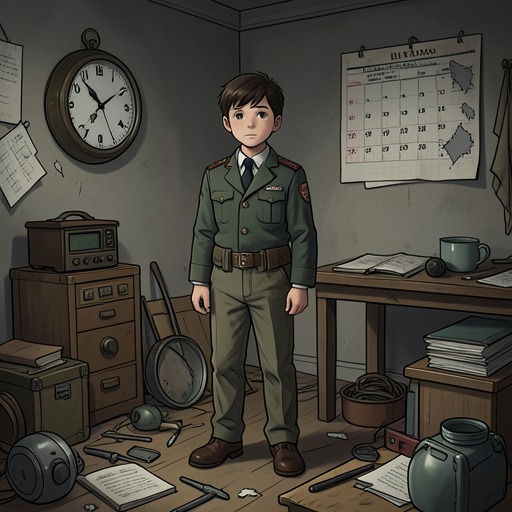
A timetable is a map of time
The Curious Incident of the Dog in the Night-Time“A timetable is a map of time” names Christopher John Francis Boone’s practical answer to an abstract problem: time, unlike a misplaced object, has no fixed location he can map, yet a timetable gives its changes an order he can follow. The expression links his reliance on routine to the concrete work of travelling from Swindon to London, where a route and its signs help him move through an overwhelming station system.
Definition and reasoning
Christopher begins with the familiar idea of a map. If a protractor or biscuit is put down somewhere, a mental map can help locate it; even without that map, the object remains in place. Time is different. Christopher understands it as the relationship among changes: the Earth revolving around the Sun, atoms vibrating, clocks ticking, day turning to night, and waking giving way to sleep. Like directions such as west or nor-nor-east, time depends on relationships rather than being a thing that exists independently.
That distinction becomes more complicated when Christopher considers motion. Relationships are not all fixed: how much time passes can depend on how fast someone travels relative to a particular point. A person travelling near the speed of light might return to find that family members have died while only days or months have passed on that traveller’s clock. Since nothing can travel faster than light, Christopher reasons, people can know only a fraction of what happens in the universe. Time therefore remains a mystery, not a thing whose nature anyone has solved exactly.
Timetables as practical maps
The phrase is not a claim that a timetable explains time itself. Christopher’s conclusion is more practical: without a schedule, time can feel like a desert in which someone is lost without being able to see the surrounding space. Timetables matter because they keep that disorientation at bay. At weekends he makes his own schedule on cardboard, including tasks such as feeding Toby, doing mathematics, and going to the shop for sweets. When his family is on holiday and has no timetable, he needs his mother and father to tell him each morning exactly what the day will involve.
The same need appears in his journey from Swindon. Before leaving, Christopher rules out possibilities until he concludes that he must go to London to live with his mother. He knows how train travel works from his model railway: consult the timetable, go to the station, buy a ticket, check the departure board, and find the correct platform. This familiar sequence turns the journey into a series of decisions he can understand, even though leaving home is not something that feels safe.
From schedule to route
The expression’s logic extends from time to navigation. At Swindon station, Christopher is frightened by the crowds, the echoing tunnel, its smell of toilets and cigarettes, and the sense that there is only one way forward. He grips a sign to keep from falling, covers his ears, and tries to plan what to do. When he cannot clear his thoughts, he solves a mathematics problem. Later, he finds a quiet corner, sits with his eyes closed, feeds Toby two pellets of rat food, and holds his Swiss Army knife while he tries to think. The station’s route is not enough by itself: he must also find a place and a method that let him regain control.
In London, maps and signs make the next stages of travel legible. Christopher reduces the crowd to people like cows in a field and imagines a red line along the floor for himself to follow. He chooses the Bakerloo line to Willesden Junction when the Jubilee line named by a woman is not on the signs he can see, then follows the left-hand tunnel and selects northbound because Willesden lies in the upper part of the map. After leaving the station, he uses the road shapes to identify Station Approach and Oak Lane. Reaching 451c Chapter Road takes 27 minutes. Each leg substitutes an ordered sequence of cues for the unmanageable whole.
Narrative significance
The expression joins an explanation of time to scenes in which Christopher must make plans under pressure. Its map is both conceptual and practical: it distinguishes the relationships that make time difficult to grasp from the timetables and directions that let him act within it. The journey shows the limits as well as the value of that method. A timetable cannot quiet a crowded station or make an unsafe-feeling choice disappear, but familiar procedures, signs, and routes give Christopher a way to proceed through uncertainty.